Appearance
Preview
- an inference problem can be formulated as a latent gaphical model where given the observed data we would like to infer the posterior probability distribution of associated latent variables, which can be usually interpreted as properties,
- the posterior is typically intractable due to typically the marginal requires an integral to compute
- variational inference uses a simp;e, parameteric distribution to approximate the true posterior and turns the intractable problem into an optimization proble,
- kl divergence measures the difference between the approximate distribution and the true posterior
- minimizing kl divergence is equivalent of maximizing evidence lower bound(ELBO)
- ELBO is negative & plays a very important role in subsequent algorithm formulations
https://www.bilibili.com/video/BV1Y57jzfE6N?vd_source=7b2584179c6dc9c18721c42b39ce63b9
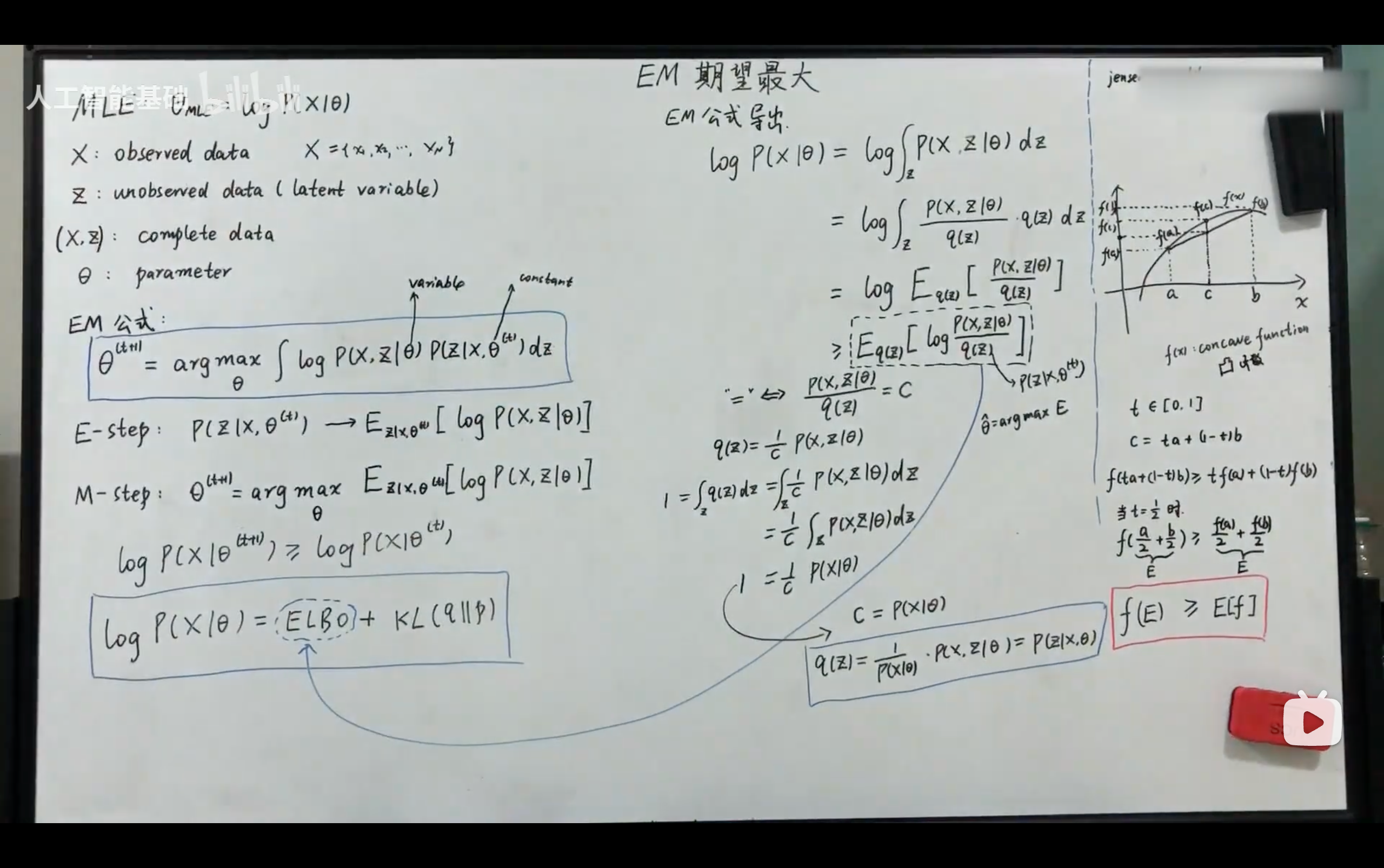
EM Algorithm
- 主要解决问题:具有隐变量的混合模型的参数估计,也就是解决它的极大似然估计。
- EM算法本身也是一个迭代算法
- z代表后验
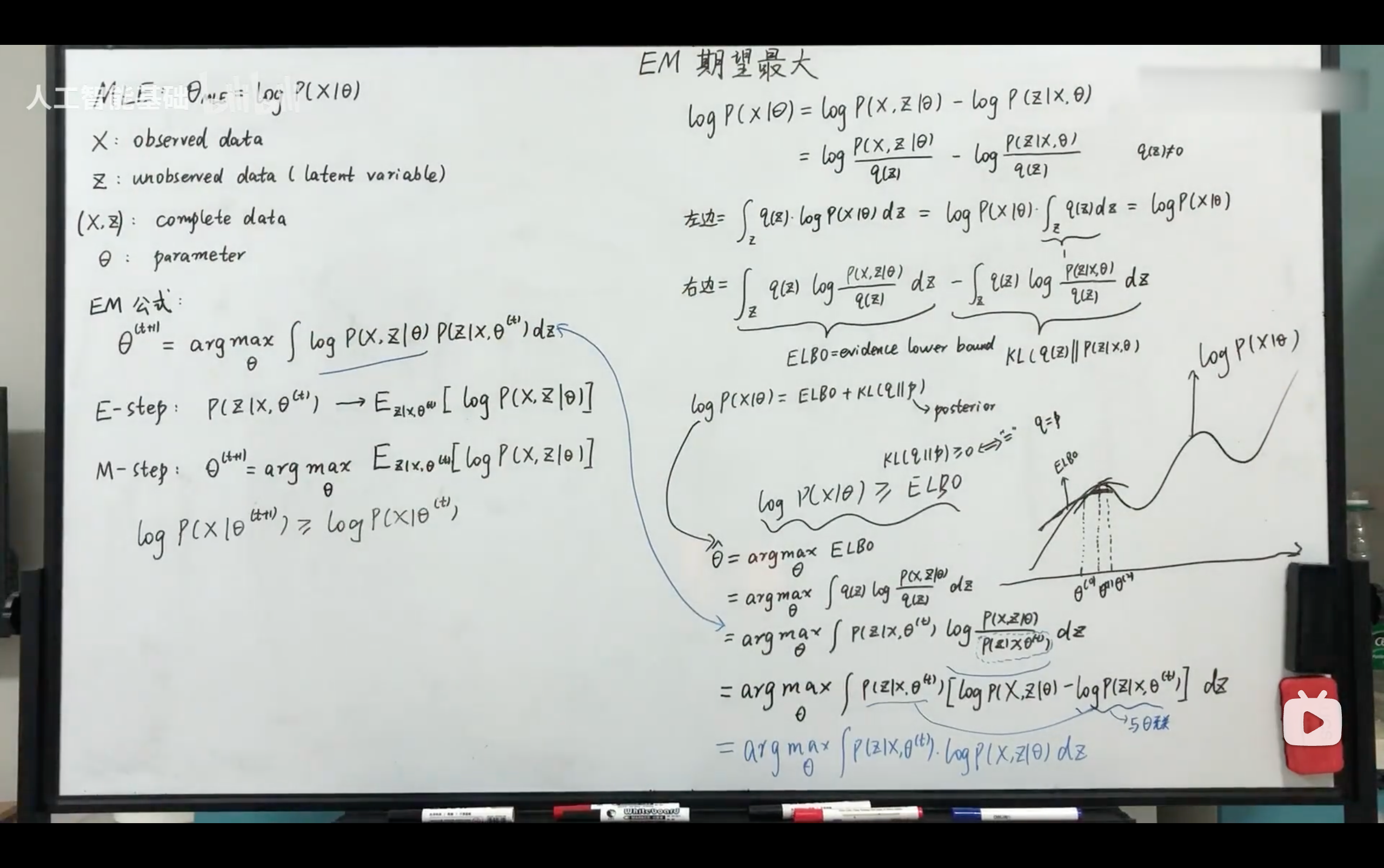
从ELBO & KL divergence角度推导
- EM的核心想法就是让ELBO达到最大,从而让log likelihood也能达到最大。
- 是一种不停攀爬的迭代方式。
- ELBO可以看作是关于后验的期望。
- 每次先固定theta值,然后去求后验,表达出来对应的期望ELBO(是一个函数),再在这个期望函数上通过改变theta值,从而实现ELBO最大,得到极大似然估计值。
- 每次先固定theta值,然后去求后验,表达出来对应的期望ELBO(是一个函数),再在这个期望函数上通过改变theta值,从而实现ELBO最大,得到极大似然估计值。
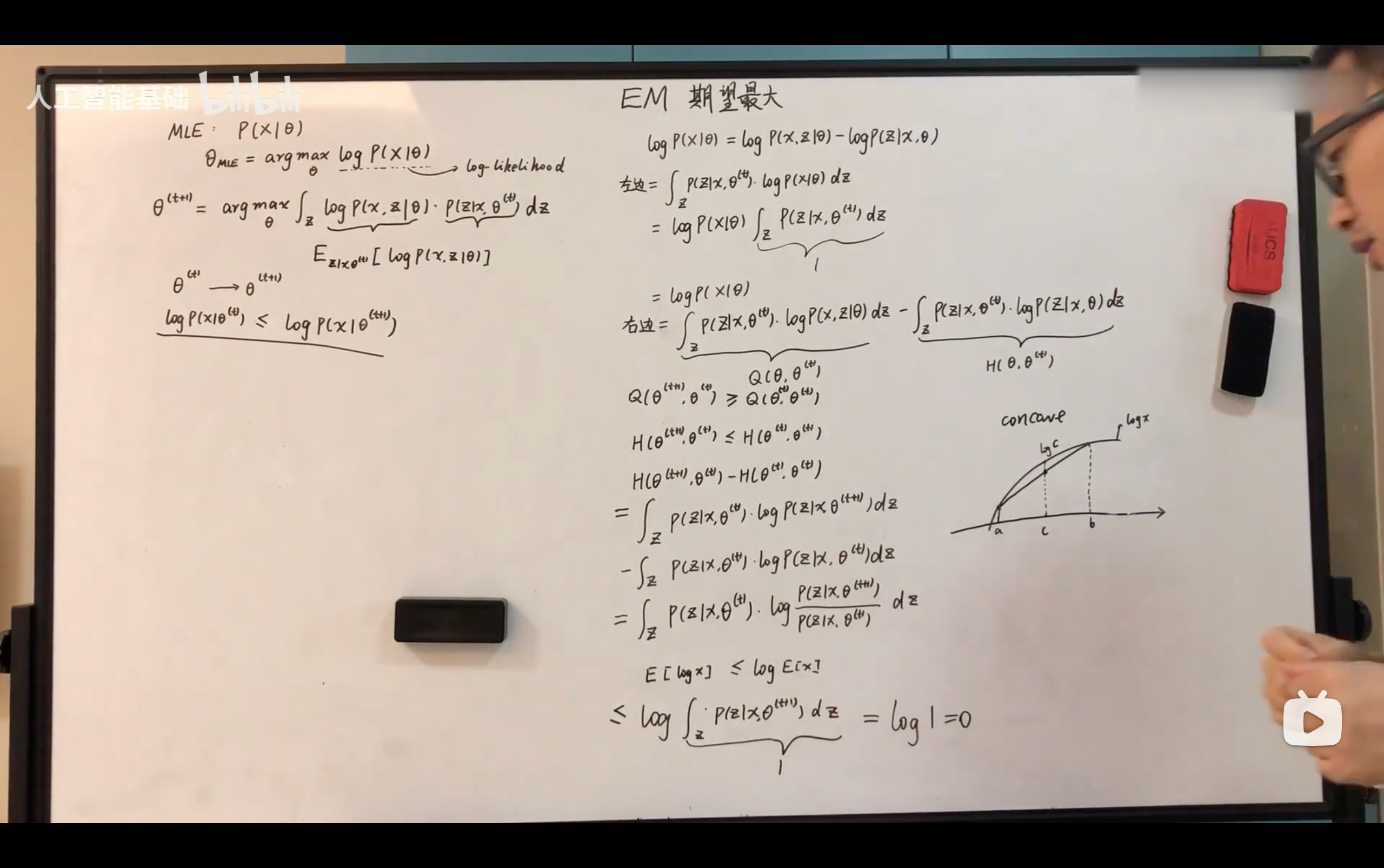
从Jensen不等式角度推导
- 积分可以想像成求期望
- 凸函数的性质可以写出Jensen不等式:
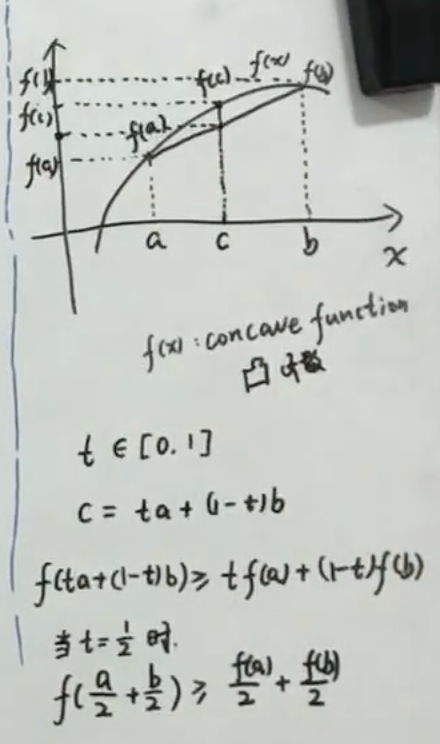
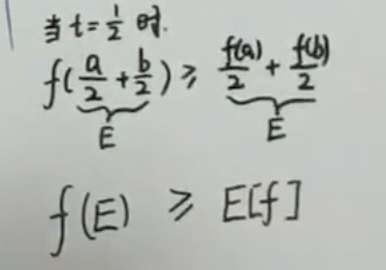
- 因此,求期望可以转换为先求其对应的函数
- 而当函数为一个常数时,这个Jensen不等式就可以取等号。
- q(z)是我们自行引入的关于z的一个分布,因此对z积分q(z)的值应为1。